Audience Analysis
Where every speaker has to begin, and the step most people skip entirely.
A six-week course with Shannon Polly, leadership coach, classically trained actor and one of the first 150 people worldwide to earn a Master of Applied Positive Psychology. Twenty-five lessons on commanding a room without pretending to be someone else.
6 weeks · 25 lessons · 6 hours · certificate · lifetime access
Join now for $199.9948-hour money-back guarantee · Secure checkout · Instant access
Six weeks working outward: the audience, your inner state, your voice and body, the structure, the story, and finally your strengths.
Where every speaker has to begin, and the step most people skip entirely.
Confidence, nerves and the voice that sabotages you before you have said anything.
Pace, pitch, projection, posture and pausing, plus eye contact, gesture and rest positions.
How to build a talk from strategy to body to introduction, including for a short-on-time audience.
The story spine, the passion pitch, and the vulnerability that makes people listen.
Presenting from your own strengths rather than imitating someone else's presence.
It is a common myth that executive presence, that essence which helps you command a room, is something you are born with. It is a set of skills, and skills respond to practice.

The thinking is sound. Getting it heard, and acted on, is where it keeps stalling.
You know the material. Something in your body decides otherwise the moment you stand up.
Pace, filler, posture, a rest position that reads as uncertainty. Nobody has ever told you.
Which is a description of the destination, not a route to it, and you have heard it enough.
Speaking slowly might read as slow, or as giving an audience time to process. Speaking quickly might read as sharp, or as losing people. Neither is wrong. What matters is that you are making the choice rather than defaulting into it.
Influence lets you lead teams, drive innovation and navigate complexity. It builds trust and respect, makes collaboration possible, and lets you inspire people to act rather than merely agree.
Discover what executive presence means, and how mastering it changes both internal and external qualities.
Spoken and unspoken communication pull in different directions until you deliberately align them.
Gain insight into how your existing presenting habits diminish your influence, and how to change them.
Develop authentic storytelling, including how sharing parts of yourself connects you to an audience.

Shannon holds a MAPP from the University of Pennsylvania and a classical acting degree from the London Academy of Music and Dramatic Art. That combination is unusual, and it is why the course covers both the inner state and the craft of delivery.
Join now for $199.99
Shannon is a leadership coach, speaker, author and founder of Lead Well Work Well, a Washington DC leadership development company. She was one of the first 150 people globally to earn a Master of Applied Positive Psychology from the University of Pennsylvania, and she holds a degree in classical acting from the London Academy of Music and Dramatic Art.
She has delivered keynotes and workshops for Google, GE, VMware, McKinsey, the US Army and the World Bank, and has run leadership programmes in Kenya, Bangladesh, Haiti and Thailand. She is an award-winning playwright and co-editor of the best-selling Character Strengths Matter: How to Live a Full Life, which is the thinking behind week six.
Shannon has delivered keynotes and workshops for Google, GE, VMware, McKinsey, the US Army and the World Bank, and facilitated leadership programmes across four continents.
An award-winning playwright and co-editor of Character Strengths Matter, she co-founded Positive Business DC and teaches positive psychology at the Functional Medicine Coaching Academy.
Where influence, not authority, is what actually moves a decision through an organisation.
Pitches, board updates, conference talks. Six weeks of craft rather than another slide template.
Week two is entirely about nerves and the inner critic, with concrete techniques rather than reassurance.
If your ideas get less traction than they deserve, this is the gap and it is closeable.
Storytelling and vulnerability, covered properly in week five, are the whole job in a pitch.
No background in psychology or performance needed. Everything is built from the ground up.
The longest course in the Infijoy catalogue for a reason: 25 short lessons with expert videos, daily tasks to apply each idea, six hours of on-demand learning and lifetime access to the videos and notes. A certificate of completion comes with it.
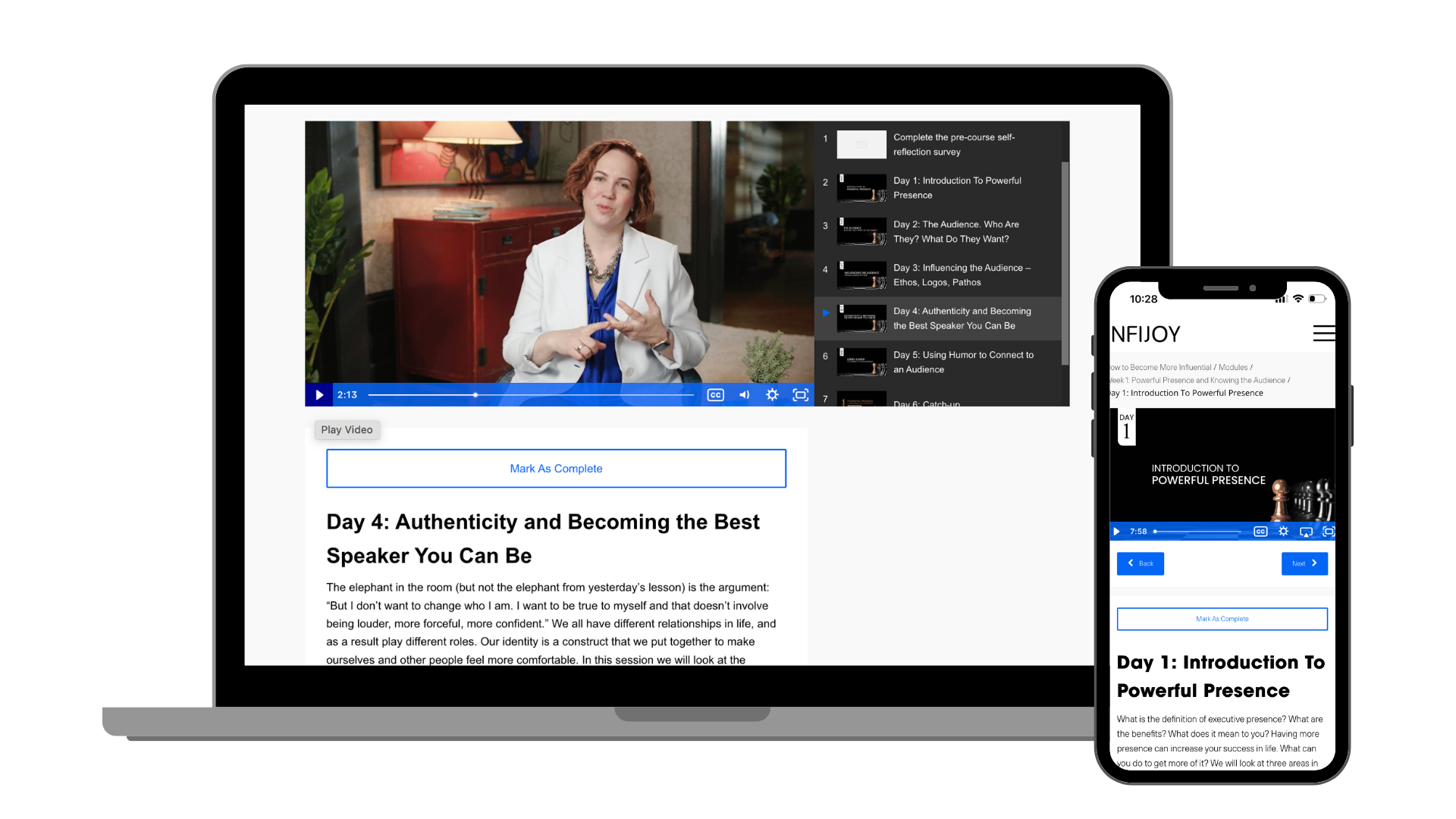
The sequence is deliberate: audience first, then your inner state, then how you sound and move, then what you actually say, and finally the strengths that make it yours.
What is, and is not, a powerful presence. The good news is that presence can be increased with practice. This week takes the first steps in reducing tension, crafting your intention and cultivating your attention, and begins where all speakers must begin: with audience analysis, and a look at structure and content.
Building confidence from the inside. This week covers your objective for a talk, then how to manage the inner critic that sometimes tries to sabotage you. There is a great deal on managing nerves: breathing and visualising, and some more unusual approaches, including eating greasy chips.
The Five Ps: pace, pitch, projection, posture and pausing, plus eye contact, movement, gestures and rest positions. Speak slowly and you might be perceived as not smart, or as giving the audience time to process. Speak quickly and people may see you as smarter, or miss what you said. The aim is to be consciously competent and making that choice.
How to prepare for a presentation and how to structure it, starting with strategy, then the body, then the introduction. The week also covers how to structure for an audience that is short on time, which is most audiences.
Presence approached from the angle of storytelling: the art and science of it, the story spine, the passion pitch, and vulnerability. Stories are crucial to being a powerful presenter. Your only real job in giving a talk is to have something valuable to say, and to say it authentically in your own way.
Presence from the angle of character strengths, referencing the VIA survey from week one. This is common ground in positive psychology, but few programmes focus on using your strengths to present, or on pulling up a lesser strength by using a top one. The week also covers acting as if you have a strength you need, and the unglamorous answer to how you get to Carnegie Hall.
If within the first two days you feel this is not the right fit, email support@infijoy.com and we will refund your enrolment fee in full, no questions and no forms.
Buy How to Become More Influential outright, or join Infijoy membership for all 37 expert-led courses.
48-hour money-back guarantee · Instant access
$299.99 billed yearly · Cancel anytime · 7-day guarantee
Still unsure? Email support@infijoy.com and we will answer.
The essence that helps you command a room. It is commonly assumed to be innate, and it is not: it breaks down into internal qualities such as intention, attention and managing your inner critic, and external ones such as pace, pitch, projection, posture and pausing. Week one defines it and the rest of the course builds it.
No. Presentations are the clearest test case, but the material applies to any moment where you need to be heard and believed, including one-to-one conversations, meetings, pitches and interviews. The audience analysis in week one works the same for one person as for two hundred.
Six hours of on-demand learning in total, across 25 short lessons over six weeks. Each lesson comes with a daily task, and this is a course where doing the tasks matters more than most: week six is explicitly about practice.
Week two is devoted to it. It covers managing the inner critic and a range of strategies for nerves, including breathing and visualisation alongside some less conventional ones. Shannon's background is in classical acting, which is a discipline built entirely around performing under that pressure.
Across the six weeks you will:
A free, widely used positive psychology assessment that identifies your top character strengths. You take it in week one, and week six returns to it to build a presenting style around your actual strengths rather than an imitation of someone else's. Shannon co-edited a best-selling book on the subject.
Yes. Start whenever you are ready and work at your own pace. Lifetime access means you can return to a specific week before a specific occasion, which is how most people use a course this long.
Shannon holds a Master of Applied Positive Psychology from the University of Pennsylvania, as one of the first 150 graduates worldwide, and a degree in classical acting from the London Academy of Music and Dramatic Art. She is a graduate of the Georgetown Leadership Coaching Program, founder and CEO of Lead Well Work Well, an award-winning playwright, and co-editor of Character Strengths Matter.
Lifetime access to all 25 lessons and the accompanying notes, so you can return whenever you need a refresher.
No. This is educational content covering communication skills and positive psychology. It is not therapy or treatment for social anxiety or any other condition, and it is not a substitute for one-to-one coaching or care from a qualified professional.
Join How to Become More Influential and spend six weeks building the presence that turns good thinking into decisions other people act on.
48-hour money-back guarantee · Secure checkout · Instant access